A faceless YouTube channel is a channel whose videos never show the creator. Instead of a presenter talking to a camera, the video is carried by a voiceover, with footage, images, animation, screen recordings or text on screen doing the visual work.
Plenty of well-known formats are faceless: documentaries, history and science explainers, list videos, finance breakdowns, true-story narration, ambient and relaxation videos, and tutorials recorded from a screen.
How a faceless video is made
The work moves through the same stages every time, whether one person does it or a team does.
- Topic research. Finding a subject the audience in that niche already wants to watch.
- Script. The script is the video. It sets the hook, the pacing and the reason to keep watching.
- Voiceover. A narration recorded by a person or generated with a voice tool, kept consistent across the channel.
- Visuals. Stock footage, licensed images, motion graphics, maps, charts or AI-generated illustrations matched to each line of the script.
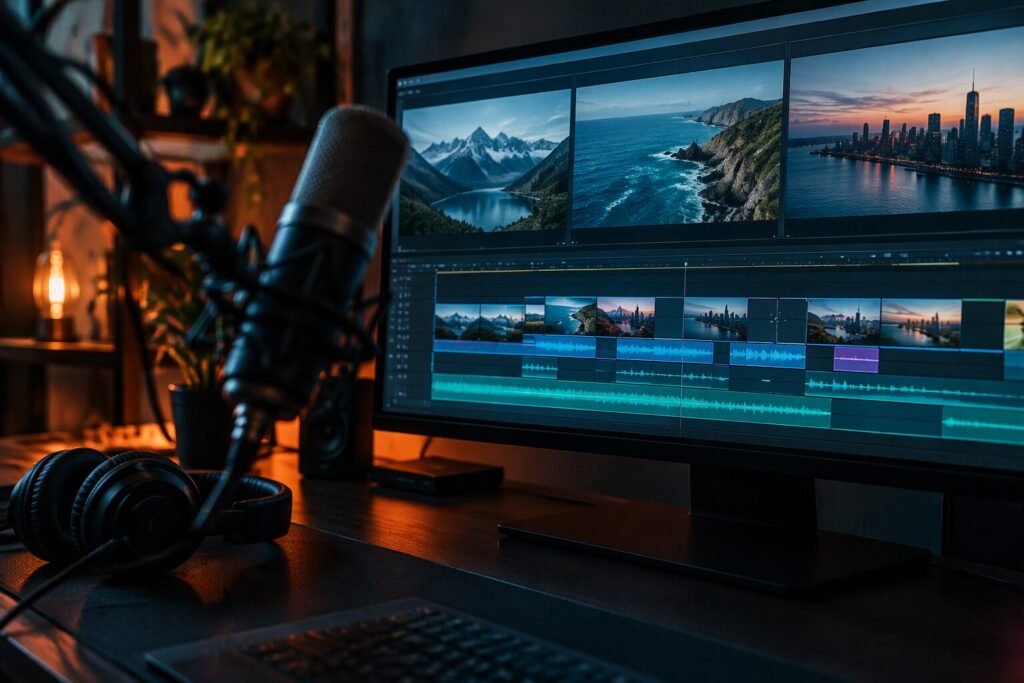
- Edit. Cutting visuals to the voice, then adding captions, music and sound design.
- Packaging. The title and thumbnail, which decide whether anyone clicks.
Why people choose the faceless format
- You do not need a camera, a studio or to be comfortable on screen.
- The channel is built around a topic, not a personality, so production can be shared across a team.
- It scales. Once a format is defined, more videos can be produced without the creator being in every one.
The trade-off is that a faceless channel has no personality to lean on. The script, the edit and the consistency of the format have to carry all of it.
Can a faceless channel be monetized?
Yes. YouTube’s monetization rules are about the content, not about whether a face appears. A faceless channel joins the YouTube Partner Program on the same thresholds as any other channel.
What YouTube does not monetize is content it treats as mass-produced, repetitive or reused without meaningful change: the same template with a few words swapped, slideshows of other people’s material, or text read out with no added value. YouTube also asks creators to disclose realistic altered or synthetic content. A faceless channel that publishes original, individually researched videos sits comfortably inside those rules. One that copies and pastes does not.
Platform rules change, so check YouTube’s current channel monetization policies before you plan a channel around ad revenue.
What makes a faceless channel work
- A clear niche. Viewers and the recommendation system should both be able to say what the channel is about.
- A recognisable format. The same voice, pacing and visual style from video to video.
- Consistency. A steady upload schedule that the production process can actually sustain.
- Scripts worth watching. Research and structure matter more than any tool used to make the video.
Doing it yourself or outsourcing
Many creators start alone and hit the same limit: writing, voicing and editing a good video takes many hours, and a schedule of several videos a week is hard to hold. That is the point where a production partner helps.
Himalix produces faceless YouTube videos for clients in their own niches, from a single video to bulk orders, and runs faceless channels of its own. If you are planning a channel, tell us about it.